Choosing the right memory for a build can feel like a minefield, especially when terms like DDR and GDDR get thrown about interchangeably by shop assistants and online forums alike. Whilst both types of memory share a common ancestry and similar naming conventions, they're engineered for entirely different jobs within your machine. Understanding this distinction isn't just academic pedantry; it genuinely matters if you're trying to build a rig for gaming, video editing, or simply want a snappy laptop for everyday tasks.
What to know
- DDR (Double Data Rate) memory acts as the backbone for general computing, optimized to handle everyday tasks like multitasking and application performance for CPUs.
- DDR technology has evolved through several generations, with DDR5 currently offering superior bandwidth and power efficiency compared to its predecessors.
- LPDDR5 is a specialized low-power version of DDR memory specifically designed to balance performance and battery life in mobile devices and ultrabooks.
- GDDR (Graphics Double Data Rate) memory is engineered specifically for GPUs, prioritizing massive bandwidth over low latency to support high-resolution textures and rendering.
- The latest GDDR7 standard significantly increases data throughput, utilizing technologies like PAM3 signaling and lower voltage to manage heat while handling intensive tasks like gaming and AI.
- DDR and GDDR serve fundamentally different roles in a computer, where DDR functions as a versatile generalist for the system processor, while GDDR is a high-speed specialist for graphics-intensive data movement.
Understanding ram ddr: the backbone of general computing performance
What is DDR RAM and How Does It Function in Modern Systems?
DDR, which stands for Double Data Rate, is the memory that handles the bulk of everyday computing tasks on your desktop or laptop. It works by transferring data on both the rising and falling edges of a clock signal, effectively doubling throughput compared to older single data rate memory. Companies such as Rambus have played a significant role in advancing this technology, creating semiconductor and IP products designed to make data transfer faster and more secure. Their portfolio spans chips, silicon IP, and security solutions that underpin much of the memory architecture found in modern devices.
Rambus offers chip solutions for both servers and client devices, with server memory supporting standards like DDR5, DDR4, and SOCAMM2, whilst client memory covers DDR5 and LPCAMM2 configurations. This dual approach reflects how DDR technology has evolved to serve everything from massive data centres to the laptop sitting on your desk. Processors from Intel's Core series and AMD's Ryzen lineup rely heavily on DDR memory to function smoothly, handling multitasking, everyday browsing, and general application performance without breaking a sweat.
DDR RAM Generations: From DDR3 to DDR5 and Their Impact on Laptop and Desktop Performance
Each generation of DDR memory has brought noticeable improvements in speed and efficiency. DDR3 was once the standard, but DDR4 quickly overtook it thanks to better power efficiency and higher clock speeds. Now, DDR5 has taken centre stage, offering substantially improved bandwidth and reduced power consumption compared to its predecessors. This progression matters because the amount and generation of DDR RAM in your system can dramatically influence how quickly applications load, how many browser tabs you can have open before things start chugging, and how well your machine copes with demanding software.
There's also LPDDR5, a low-power variant specifically designed for mobile devices and ultrabooks where battery life is just as important as raw performance. This variant demonstrates how DDR technology isn't a one-size-fits-all solution but rather a family of standards tailored to different use cases, from power-hungry workstations to slim laptops that need to sip energy rather than gulp it.
Gddr memory explained: why graphics cards require specialised ram
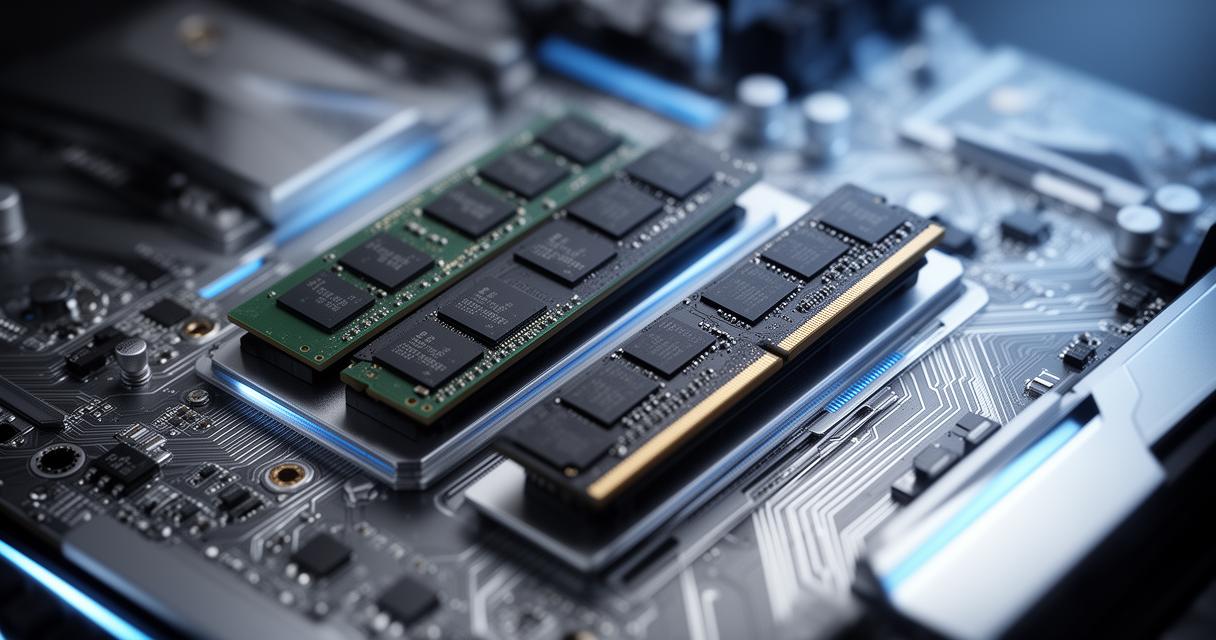
The Architecture of GDDR RAM: Optimised for High-Bandwidth Graphics Processing
Graphics Double Data Rate memory, or GDDR, takes a fundamentally different approach to solve a different problem. Whilst DDR prioritises low latency for a wide variety of general tasks, GDDR is built for sheer memory bandwidth, shovelling vast quantities of data to and from the GPU as quickly as possible. This is essential because rendering high-resolution textures, complex lighting effects, and smooth frame rates demands an enormous amount of data movement in a very short space of time.
The latest iteration, GDDR7, exemplifies just how far this technology has come. Launched in March 2024 with mass production following in 2025, GDDR7 introduces some genuinely impressive advancements. It achieves speeds of up to 48 Gbps per pin and delivers a staggering 192 GB/s of bandwidth per device. These figures represent a substantial leap forward, making GDDR7 considerably faster than traditional DDR memory and particularly well suited to high-resolution tasks that would bring lesser memory types to their knees.
GDDR Variants in Gaming: Exploring GDDR5, GDDR6, and GDDR6X Technologies
Before GDDR7 arrived on the scene, gamers and content creators relied on earlier variants such as GDDR5, GDDR6, and the enhanced GDDR6X. Each generation improved upon bandwidth and efficiency, allowing graphics cards to keep pace with increasingly demanding games and creative software. NVIDIA's GeForce GTX series, along with more recent RTX cards, have long depended on these memory types to deliver the smooth, high-fidelity visuals that gamers expect.
GDDR7 distinguishes itself through several key advancements that set it apart from its predecessors. It operates at a lower voltage of just 1.2V, which helps manage heat output and power consumption despite the massive increase in speed. It also employs advanced PAM3 signalling, a technique that allows more data to be encoded per signal transition compared to older methods. Perhaps most notably, GDDR7 features four separate 10-bit channels, enabling increased parallelism that lets the memory handle multiple data streams simultaneously with remarkable efficiency.
DDR vs GDDR: Performance Comparison for Gamers and Content Creators
Speed and Throughput: How MHz Ratings Differ Between DDR and GDDR Memory
When comparing these two memory families directly, the differences become stark. GDDR7 outperforms not only DDR memory but also stands up well against other specialised memory types like GDDR6, GDDR6X, and even HBM3, which is a different architecture entirely optimised for data centre applications. Whilst HBM3 excels in server environments handling colossal workloads, GDDR7 has found its niche as the go-to choice for AI inference and gaming applications where speed and responsiveness are paramount.
The distinction really boils down to purpose. DDR memory is a generalist, competent across a huge range of tasks from word processing to software development, but it simply isn't built to shift the sheer volumes of data that a modern graphics card demands during intensive gaming sessions or video rendering work. GDDR, by contrast, is a specialist that sacrifices some flexibility for blistering throughput in exactly the scenarios where it matters most.
- DDR memory suits general system tasks, multitasking, and everyday computing needs.
- GDDR memory is purpose-built for graphics-intensive workloads like gaming and video editing.
- HBM3 serves data centres and enterprise-level computing where different priorities apply.
Choosing the Right RAM Configuration: Balancing System Memory and Graphics Card Requirements
For anyone building or upgrading a system, the practical takeaway is straightforward. Your system's general performance depends heavily on having sufficient, fast DDR memory paired with a capable processor, whether that's an Intel Core chip or an AMD Ryzen unit. Meanwhile, your graphics card's ability to handle demanding games or content creation software rests squarely on the quality and generation of its onboard GDDR memory.
Content creators editing high-resolution video or working with complex 3D renders will particularly benefit from graphics cards equipped with newer GDDR6 or GDDR7 memory, as these workloads lean heavily on graphical throughput rather than general system RAM. Gamers chasing high frame rates at demanding resolutions face a similar equation, where the graphics card's memory often becomes the limiting factor long before system RAM does. Ultimately, striking the right balance between ample DDR for your system and capable GDDR for your graphics card ensures that neither component becomes a bottleneck, letting you get the most from whatever tasks you throw at your machine.